
Robert Redford and The Candidate
Along with All the President's Men, one of the most influential movies of my career...

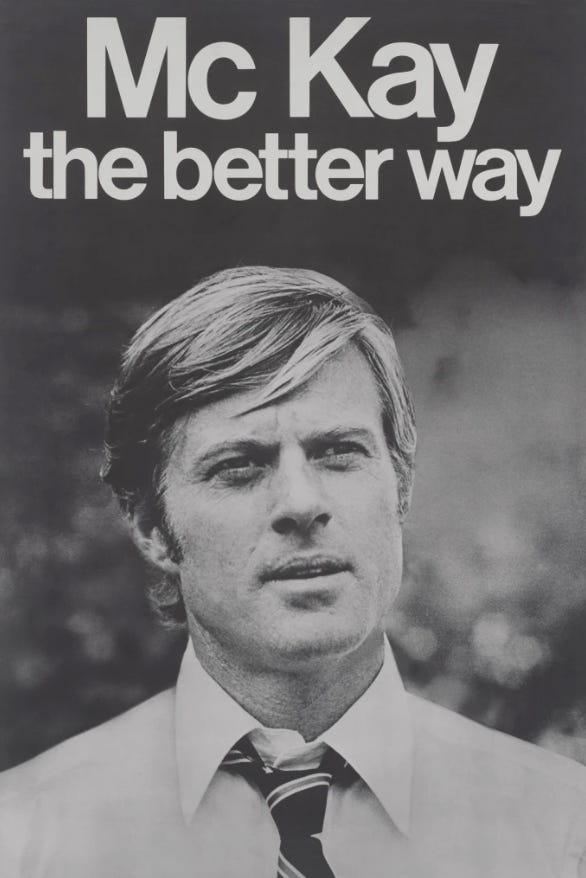
The death of Robert Redford at 89 immediately made me think of his classic 1972 film, “The Candidate”.
Redford plays a California U.S. Senate candidate named Bill McKay, who happens to be the son of a former governor named John J. McKay.
The parallels between former Gov. Jerry Brown and his father, former Gov. Edmund G. ‘Pat” Brown, are obvious, but McKay was actually modeled from the late California Sen. John V. Tunney, who won election in 1970. However, by 1972, Jerry Brown was an obvious rising political star in the Golden State as well.
I first saw The Candidate when I was 12, and had foreshadowing of what I would eventually do for a living later.
I had no idea how close that foreshadowing would be, not just for me, but for the country--and how dreadfully putrid American politics have become since The Candidate was released.
To me, a fascinating element of the film was how they integrated virtually every major California political journalist into most scenes. The list of credits reads like a Who’s Who of California politics. I’ve even met and known a person or two from that era of California political journalism, most notably the great George Skelton of the Los Angeles Times. Marty Nolan from the Boston Globe is a friend as well, and George and Marty were actual Boys on the Bus, the landmark Timothy Crouse book about the 1972 campaign.
One scene shows McKay and his wife disembarking from a chopper labeled “SFO”, while one of his aides shows the couple a newspaper and screams over the rotors, “Five columns in the Chronicle!”
About 45 years later, I found myself writing about the 2024 U.S. Senate race, and yes, a few times, I got five columns in the Chronicle.
I even had a few coffee mugs made from screenshots of The Candidate, one listing all the journalists in the credits. I enjoy seeing it most mornings when not looking at my custom Apollo 11 moon landing mugs I also had made.
I am assiduous in my obsessive behavior.
Comparing how a movie U.S. Senate race and a real live U.S. Senate race worked constantly ran through my head, almost every time I wrote about Schiff, Porter, Lee, and Garvey.
In McKay’s now-quaint seeming senate race, his opponent was a fictional gray-haired Sen. Crocker Jarmon, who also was chairman of the Senate Finance Committee. Jarmon was about 20 years older than the youthful, tousled-coiffured McKay.
Several major politicians over the years have compared their own looks to those of Robert Redford, including former Vice President Dan Quayle and President Donald Trump.
Uh, yeah, no.
Jarmon was strictly old school GOP, noting his affiliation to, gulp, President Dwight Eisenhower, who would be radioactive anathema in today’s Republican Party, what with their insistence on unraveling NATO and all. Jarmon was never portrayed as a liar or a buffoon, just out of it.
That’s so yesterday.
At the time, The Candidate was viewed as a realistic insider’s view of a major statewide race. There were slovenly, unshaven aides (but no women aides), messy room service dishes in hotel rooms with flipcharts, indoor cigarette smoking, Styrofoam coffee cups, failing public address systems, balloons, and all the old school accoutrements of a political campaign.
No one on the McKay campaign tweeted, or did parodies of the other candidates tweets, nor did they call their opponent “senile”. There was the usual hip-checking, but it wasn’t bloodsport.
However, the film was predictive of the future in a subtle way. It tried to illustrate a system increasingly bogged down by superficiality in 1972.
One scene shows ABC News commentator Howard K. Smith opining that in the California Senate race, McKay’s once fresh ideas had turned to mush because of “socko salesmanship” and that McKay was being sold like a new detergent—“no moral or ethical considerations at all”.
Smith would be put on a Trump domestic terrorist list now.
The marketing of The Candidate made it seem more like a comedy than anything else (it was at times amusing, but not a comedy), and the original marketing of Redford’s character was that of a cypher, an empty vessel in which political consultants poured their wisdom.
In fact, Redford’s character became fairly shrewd, ultimately committed to his message from his work as the owner of a free legal aid clinic, and finally gained confidence in what he was saying and in himself by the time the credits rolled.
My dear friend and mentor David Sarasohn also noted to me that McKay did, in fact, trim some of his positions throughout the film, and caved on abortion, which he said “deserves a lot more study that it’s been getting”, and also recalled that McKay caved to the powerful Teamsters Union president after saying “I don’t think we have shit in common”, and that “you didn’t do much good trying to break up the farm workers”.
This is why David has a PhD in history and I don’t.
Idealistic statewide candidates like McKay are increasingly hard to find, for the California power structure mostly doesn’t let them happen much. A hardscrabble background is more an obstacle than ever, unless you’ve got Peter Thiel writing you five million dollar checks.
That’s where we are in 2025. Thiel doesn’t care what you believe, as long as it’s what he needs you to believe. He found his own little yucky creepy McKay in Vice President JD Vance, who went from a newbie U.S. senator from Ohio in 2019 to second-in-line to the presidency in five years—and maybe he'll have his guys cancel the election in 2028.
To win a statewide race in California now, you’d probably want to start with $100 million and see how it goes from there. Between Theil and Elon Musk, The Candidate now seems like a 20th century idyll, a snapshot of utter sanity in a nation where two of its wealthiest, weirdest people are calling the shots.
When television producer Mark Burnett created The Apprentice, he cast Trump as not only a CEO, but in turn created his national brand that led to the presidency. Now Trump is suing The New York Times for saying just that.
If you thought Bill McKay was a privileged son/empty suit/media creation, try the 47th president of the United States.
At the end of The Candidate, a perplexed Sen.-elect Bill McKay asks his campaign manager plaintively, “Now what do we do?”
Note that his constituents didn’t ask that.
But that’s where we are now. The trajectory that The Candidate illustrated leading to our current desperate politics leaves us asking, “Now what do we do?”
If this is the sequel to The Candidate, we’re running out of options.
McKay's slogan in The Candidate was, "There's Got To Be A Better Way".
In 2025, there isn't one.
*************************
Hey, YBs! : Hope you’re having a great day. More to come. —J.
It came as no surprise that the Redford obit I saw didn't mention The Candidate. Could be my favorite R R film, so excellently cast: Up and coming Peter Boyle; the eminent M Douglas; and Ann Southern's boss, Don Dafore, on TV's Private Secretary who played in several other sitcoms.
One of my favorite character actors, Kenneth Tobey, nailed the juicy role of the union guy, mischievously named Floyd Starkey. Tobey was the lead in the original The Thing which I saw at the Alhambra in 1951. Scared the bejesus out of me. The Candidate is in a class of its own.
This was such an interesting column, Jack. I am certain that I saw “The Candidate,” because my late husband loved movies and nearly every weekend of our 33 year marriage was spent at a movie theater on a Saturday night. I hope that I can find this movie and watch it again. I need to refresh my memory. I long for simpler times.