

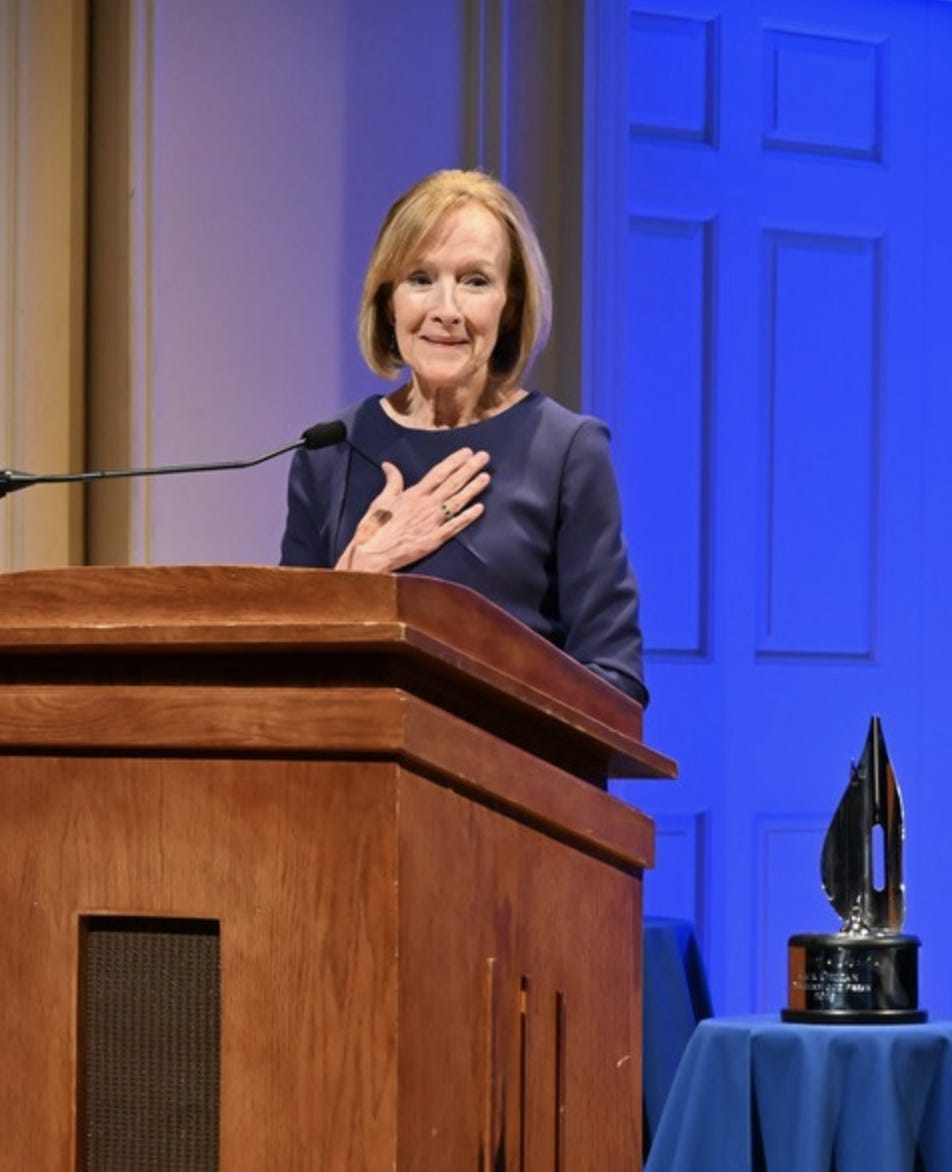
PHOTO: BRUCE GUTHRIE
I had the honor of having Judy Woodruff as the annual Herblock prize lecturer.
She’s very lovely and low-key in person, and I really enjoyed seeing her and her husband, the legendary political journalist Al Hunt, formerly of the Wall Street Journal. Judy is doing a monthly segment on NewsHour, which she anchored until 2022, and, before that, most everything else on NBC and CNN.
Al was someone I had watched when I was first getting interested in politics in 1976, and he was on all the shows for decades—a thoughtful, funny man.
Here are her remarks as transcribed:
******************************************************
Thank you, Ruth.
My friend, a great journalist and a powerful addition to The New Yorker since she arrived there last year, after more than two decades at the Washington Post.
Thank you to the Foundation Board for inviting me.
What an honor to be asked to talk about Herb Block, one of my heroes, and about a free press.
And to have a chance to praise Jack Ohman.
To the selection committee: you chose the perfect recipient for the Herblock Prize this year.
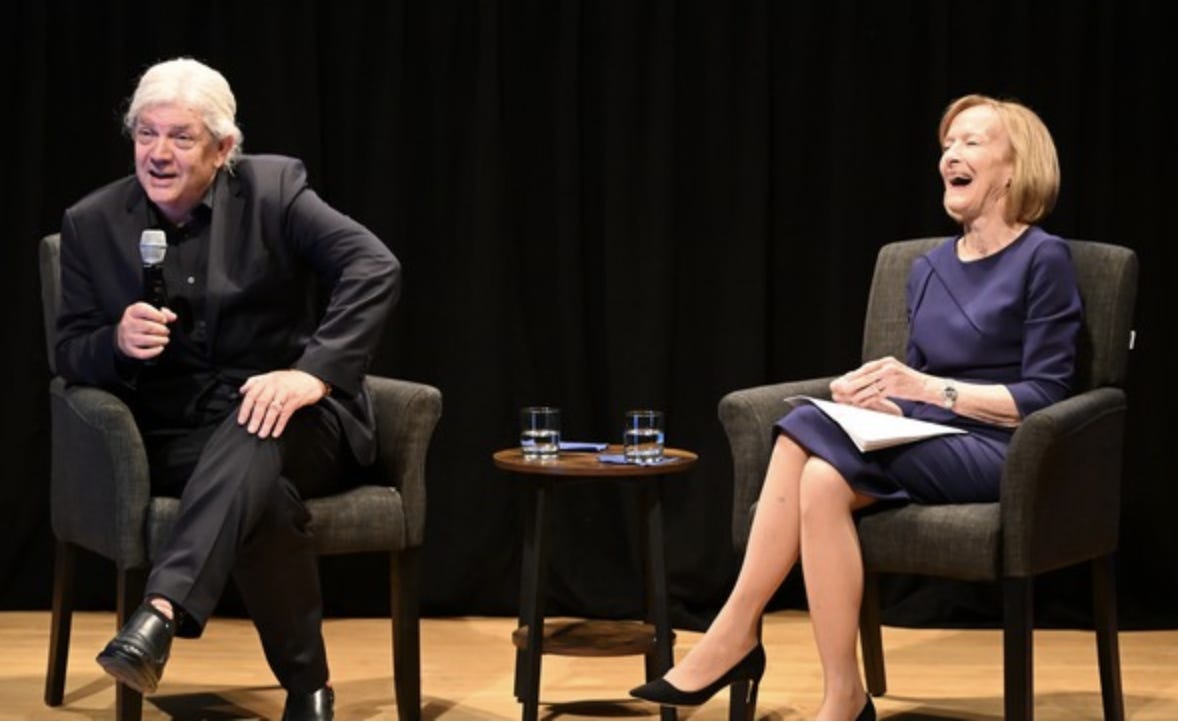
PHOTO: BRUCE GUTHRIE
Me doing a Minnesota accent.
He and I actually have a connection: in 2015 Jack drew a series of panels of cartoons with a truly moving story line for the PBS News Hour, about caring for his father in his final years, about their not-always easy relationship while Jack was growing up, and then recounting all he did with and for his dad in the final season of his life. The hard conversations, personal care that no one likes to talk about, but that is a reality for people as they near the end of life and for some with disabilities.
Jack, the News Hour was and still is incredibly proud to show that work. It is still available on the News Hour website and I recommend it to everyone.
As for his day job, Jack’s up there with the best. Just look at this Ohman cartoon …
(SCREEN SHOWS OHMAN CARTOON: “The New Kennedy Center”)
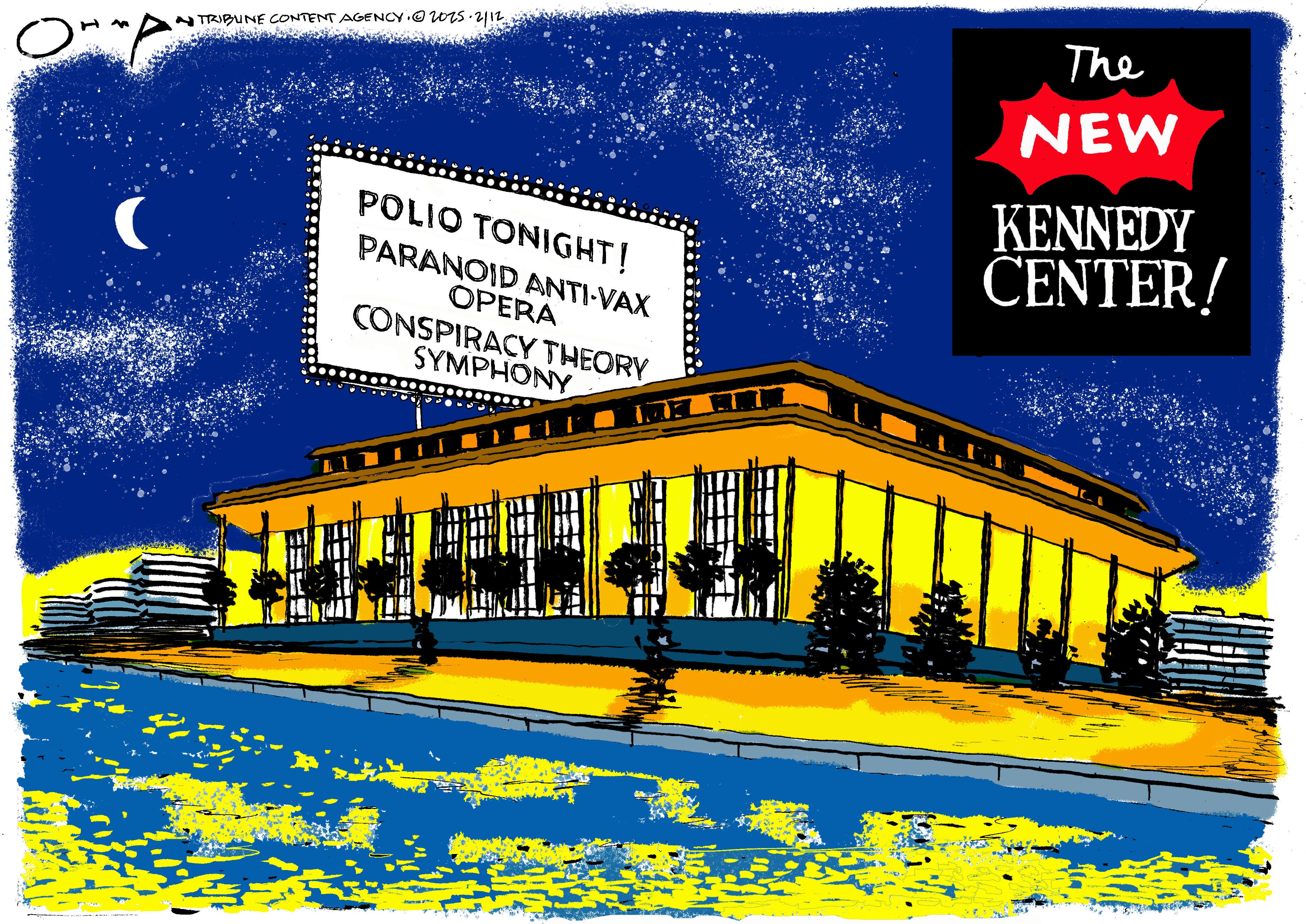
His own distinct style, but so Herblock-ian.
And there’s another side to Jack that we’re reading in his Substack columns...the last couple about his visit this week to Washington, to Arlington National Cemetery, and to the graves of President John F. Kennedy and his brother Robert, remembering his own family’s visit to the gravesite when Jack was just 7 years old.
Thank you Jack for sharing all your sides with the rest of us.
Over the course of his long career, Jack’s cartoons have been syndicated, he’s written ten books, he’s been active in charities and he’s raised six children. I get tired just reading that sentence.
I’ve long been a fan of yours.
Congratulations again!
And what about the man for whom this prize was named: Herb Block?
After a start in Chicago, a Pulitzer Prize winning stint in Cleveland, and service in World War II, Herb spent the next 55 years as the conscience of the country, as the editorial cartoonist for the Washington Post.
I calculated I was living in DC for about 40% of that time. I knew him only a little – just enough, whenever I was lucky enough to bump into him around town, or to have a chat -- every time to be awed by the tall, friendly man with a huge smile. And I ALWAYS looked forward to his cartoons. It was ritual. Back in the day when all of us went to the front door every morning to find the paper.
My husband Al was here before I, reporting for the Wall Street Journal during Watergate. He talks about how they’d go down to the Post offices at night, waiting for the first edition to come out. First to see what Bob Woodward and Carl Bernstein had on the front page, and then, turn to Herblock.
His legacy is extraordinary. If you haven’t seen it, I urge you to find a DVD of “Herblock: The Black and The White“ a marvelous HBO documentary released in 2013, produced by George and Michael Stevens.
It grabs you at the start, with Herb saying simply the role of an editorial cartoonist is to take on corruption.
One of the many things I learned from watching is how much Herb respected his colleagues at the Post, how he would go around the newsroom, showing selected reporters what he was working on, to make sure his take was well-grounded. They’d be intimidated that the great Herb Block was asking THEIR opinion.
By the way, the documentary’s producer, George Stevens, our dear friend, who is here this evening…. gave this lecture 16 years ago. And a few years after, another dear friend, and my then co-anchor at the NewsHour, the late iconic Gwen Ifill, was the speaker. There have been a few other Herb Block lecturers you may have heard of: Ben Bradlee, Barack Obama, Jim Lehrer, Mark Shields, Tim Russert, Garry Trudeau, John Lewis, Bob Woodward, Justice Stephen Breyer.
No pressure, Judy ....
As for the documentary, it mixes some delightful video of Herb, including his riding a bicycle at the beach, with interviews with journalists and others who knew him, to fill out the picture of who Herb was and to show some of his most unforgettable work.
Even before the Washington Post, he was ahead of almost everyone else. He was one of the first to warn about the dangers of Hitler, years before World War II broke out.
Well before Edward R. Murrow’s famous take-down of Senator Joe McCarthy, Herblock was skewering the demagogue from Wisconsin.
(SCREEN SHOWS SEN. JOE McCARTHY)
Twenty years later, he was just as prescient on Watergate. Just days after the break-in at Democratic party headquarters, Herb connected what happened to Richard Nixon.
(SCREEN SHOWS NIXON & 2 OTHERS AT THE DNC DOOR)
Herb certainly wasn’t anti-capitalist: witness how he was able to endow this wonderful Foundation. But he had a special contempt for the big money, special interests and how easy it was for them to buy influence.
(SCREEN SHOWS BIG MONEY OVER THE CAPITOL)
That one he drew, less a year before his death.
And there was no greater champion of the poor, or of civil rights:
Like this one in 1958 – a group of white men telling a Black man dressed in a suit, carrying a briefcase, “Nah, You Ain’t Got Enough Edjiccashun to Vote.”
(SCREEN SHOWS WHITE MEN SNEERING AT BLACK MAN CARRYING BRIEFCASE)
Herblock was the bete noire of bullies like Joe McCarthy. As important, he was a champion of underdogs, of the civil rights of those who couldn’t help themselves.
As Marilyn Berger wrote in Herb’s obituary for the New York Times in October, 2001, “His pen was dipped less in acid than in a well of perpetual indignation as he cut to the heart of the follies and foibles and outright criminal conduct of world leaders.”
And having been a White House correspondent during the Carter Administration, I can testify he could be as tough on Democrats as he was on Republicans.
Boy, could we use Herblock today.
For him it might be like what satirist Mark Russell said when asked about his work during Watergate: It was, he said, just RIP and READ.
Just imagine what Herb Block might do today with:
President Trump’s $ 1.8 Billion dollar, what appears to be a government slush fund to benefit his allies, including people prosecuted for the January 6th attack on the U.S. Capitol.
-- The billion-dollar ballroom - the 250 foot arch in front of Arlington Cemetery - - crypto currency.
It might make the treatment of Richard Nixon look benign.
-- Or Kash Patel and his signature FBI bourbon bottles.
-- A member of no political party, but clearly a progressive, he was, as we said, tough on Democrats. You can picture him savaging Eric Swalwell - and anyone closely associated with Jeffey Epstein, Republican or Democrat.
Those Epstein assault victims would have had no greater champion than Herblock. As would so many immigrants, the people of Minneapolis, anyone struggling and suffering. Shooting victims whether at school, in a synagogue, a mosque or a church.
He was a passionate defender of the free press, the First Amendment. He believed the main job of the press was to hold the powerful accountable. In addition to his three Pulitzer Prizes and so many other recognitions, he was presented the Elijah Lovejoy award – named after the famous newspaper editor and abolitionist - for his support of freedom of speech and freedom of the press.
Which brings us to today. Our business is in turmoil. Journalism, especially local journalism, is in crisis. Over the past two decades, more than 3,500 newspapers – dailies and weeklies - have shut down across the country. In other words, 40% of all local papers have vanished, with at least a couple more closing their doors every week. The respected Poynter Institute says more than 200 counties nationwide have no local news outlet; leaving fifty million Americans with severely limited access to reliable information. (Another 15 hundred have only ONE news outlet.)
Some non-profits like Mississippi Today and the Baltimore Banner have filled a void. Other places are still trying a for-profit model. But so many others are searching for answers.
I reported from one of those counties in the Texas panhandle: Hemphill, and its county seat, Canadian. Population: 2200. For 130 years, the weekly paper, the Canadian Record, indispensably served the community. Then, three years ago, it ran out of resources and folded.
In her decades as owner and editor Laurie Brown reported on deadly car accidents at one particular intersection, leading finally to the first traffic light in the community; the need for an assisted living center; the impacts of droughts and wildfires; as well as babies born, marriages, football games won and residents lost.
A conservative rancher in the county, a man named Steve Rader, had tears in his eyes as he described to me what the paper had meant to him and generations of his family, even if he didn’t always agree with the editorial page.
We know two realities about whether there is a local news outlet. One is, without one, taxes usually are higher as there is less accountability for government officials. Two, with a news organization, voting rates are higher, underscoring that Democracy works better with an informed citizenry.
It’s difficult but there are important organizations working to bolster local journalism: the MacArthur and Knight foundations, Sarabeth Berman’s American Journalism Project, the Lenfest Institute.
Nationally, it’s a different landscape with social media, podcasts and ideological cable outlets. But the mainstream media -- including my home, the PBS NewsHour -- still is a critical force in holding politicians accountable, and reporting and explaining international and national news, complicated matters like artificial intelligence. Thanks to loyal viewers, listeners and followers, and to my PBS and NPR colleagues, public broadcasting is not only still standing, we are doing some of our best work ever. Across the board, there are some outstanding reporters and some invaluable reporting.
There also are some national news organizations, with resources, that are paying off rather than fighting baseless lawsuits, putting corporate interests ahead of journalistic values.
There is political pressure from supposedly independent agencies.
Let me share a story about the way it should be. This was during the Kennedy Administration. Newton Minow was chairman of the Federal Communications Commission. One night a furious President Kennedy called him to complain about a piece on NBC News and told him to do something about it.
The next day Minow called White House aide Kenneth O’Donnell, and told him the President is fortunate to have a friend at the FCC who ignores it when the President calls with an angry request.
For years, relying on Supreme Court rulings: Sullivan versus New York Times, and the Pentagon papers decisions, most of us in the press felt pretty secure.
That has changed. It started before this Administration. Under President Obama, the Justice Department charged a Fox News correspondent as a “criminal conspirator” in a leak case; and it sought to indict New York Times James Risen for revelations about a botched CIA operation..
It’s gotten worse. I don’t like it when my profession is called an enemy of the American people. That’s rhetoric.
Actions matter more. The Pentagon has sought to deny access to reporters who wouldn’t conform to their coverage conditions. The White House has blocked AP reporters from the press pool because the wire service still refers to the Gulf of Mexico.
Other actions are more chilling. The FBI raided the home of the Washington Post’s Hannah Nathanson, seizing her phone, her work computer, her personal laptop and smart watch. They were looking for her sources on stories the government didn’t like.
Wall Street Journal reporters have been subpoenaed for a story on how President Trump was warned back in February about the risks of a war with Iran. That is a move more about embarrassment than national security.
On our 250th anniversary as a country, it’s important that we remind the public of the values embraced in the Declaration of Independence, and that that First Congress, thirteen years later, approved the Bill of Rights, with the leading Amendment on freedom of religion, speech and the press.
The legal challenges to that freedom now, especially with an aggressive Justice Department, are daunting. The highly-respected Reporters Committee for Freedom of the Press reported it was involved in a record 120 legal cases, state and local, just last year.
In this environment it’s more critical than ever that the press vigorously pursue its job with a commitment to fairness and transparency, and a refusal to be intimidated. All of us probably need to do a better job of explaining the centrality of a free press to our democracy, a truth that should transcend our polarized policies.
I wanted to close with an inspiring comment about the press. I was tempted to turn to that often-quoted, observation of Thomas Jefferson. “WERE IT LEFT TO ME TO DECIDE WHETHER WE SHOULD HAVE A GOVERNMENT WITHOUT NEWSPAPERS OR NEWSPAPERS WITHOUT A GOVERNMENT, I SHOULD NOT HESITATE A MOMENT TO PREFER THE LATTER.”
However, at the News Hour, my boss, Sara Just, who’s here this evening, reminds us always to be fair and to provide context.
In that spirit, we should remember that Jefferson’s ringing embrace of newspapers was written in 1787. Twenty years later, near the end of his second term as President, his sentiment changed: “NOTHING CAN BE BELIEVED WHICH IS SEEN IN A NEWSPAPER,” which he called “POLLUTED VEHICLES.”
So, I turned to a better observer than Jefferson on this topic: “IT’S NOT THE BUSINESS OF GOVERNMENT TO TELL NEWSPAPERS WHAT TO PRINT OR TELEVISION WHAT TO BROADCAST. AND IT’S NOT THE BUSINESS OF NEWSPAPERS OR BROADCASTERS TO CURRY FAVOR WITH GOVERNMENT.”
That was HERBLOCK.
Thank you.
Congratulations Jack! A well deserved honor!
Bravo Jack. You were both wonderful. Please post when you get the videos. I want to share those. In the case of both speeches the delivery was a good part of the impact. Wow. Congrats.